
Jaisalmer Fort: Complete Guide to the Golden Fort of Rajasthan
Jaisalmer Fort, also known as Sonar Quila, is a 12th-century hilltop fort still lived in today, with homes, temples, and havelis carved from the same golden sandstone as the city around it.
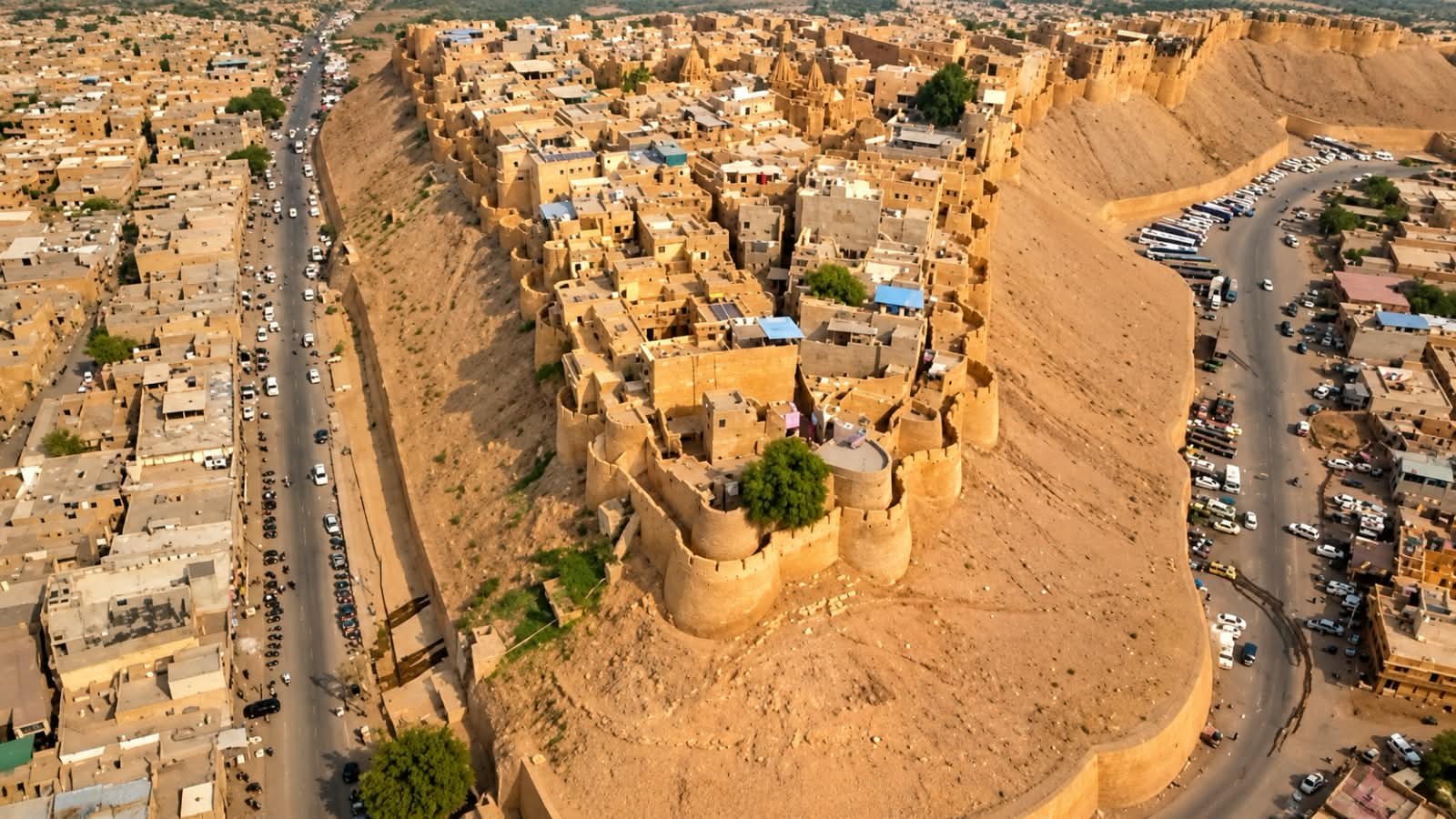
Jaisalmer Fort rises from Trikuta Hill in the heart of the Thar Desert. It is one of Rajasthan’s most recognisable heritage sites, and one of the few forts in the world that people still live in. Builders used local yellow sandstone almost everywhere, which gave Jaisalmer its nickname, the Golden City.
Most historic forts are monuments only. This one is a living neighbourhood, with homes, shops, temples, and guesthouses along its narrow lanes. If you plan to visit, knowing its history, layout, and practical details makes the trip far more rewarding. You can also explore more Jaisalmer travel guides on our website.
What Is Jaisalmer Fort?
Jaisalmer Fort is a hilltop fortification in Jaisalmer, Rajasthan. Rawal Jaisal, a ruler of the Bhati Rajput clan, built it in 1156 CE as the capital of his kingdom. It sits on Trikuta Hill, a sandstone ridge that rises from the flat desert. For most of its history, the fort has been the core of Jaisalmer city. Settlements outside its walls appeared around the 17th century, when the population outgrew the fort.
The fort is still inhabited today. Residents, commonly cited as roughly a quarter of the old city’s population, live, work, and worship inside its walls. That makes it one of the world’s few surviving “living forts”, alongside Carcassonne in France.
Why Is It Called the Golden Fort?
People know the fort as Sonar Quila, or the Golden Fort, because of its yellow sandstone. The stone turns a distinct gold in sunlight. The effect is strongest in the early morning and late afternoon, when the walls and bastions glow against the desert. Builders used the same sandstone across the city, so Jaisalmer itself is called the Golden City.
History of Jaisalmer Fort
Founding by Rawal Jaisal
Rawal Jaisal founded the fort in 1156 CE. He moved his capital here from the nearby site of Lodhruva. The location was a smart choice. Trikuta Hill offered a commanding, defensible position. The region also sat on trade routes linking India with Central Asia and Persia, including branches of the Silk Road. Merchant families grew rich on this trade. They built many of the elaborate havelis that still stand in and around the fort.
Sieges and Rebuilding
Over the centuries, the fort withstood several major sieges. It became a focal point of conflict between the Bhati rulers, the Delhi Sultanate, the Mughals, and other regional powers. One of the most significant came in 1299 CE. Alauddin Khalji, the Sultan of Delhi, besieged the fort after Bhati forces raided one of his caravans. Accounts of these sieges place the Rajput defenders within the tradition of defending forts to the last, including the practice of jauhar among the women of the garrison. Builders constructed or substantially rebuilt many of the fort’s 99 bastions between 1633 and 1647.
UNESCO Status Today
Sea routes later reduced the importance of the overland caravan trade, so Jaisalmer declined as a trading hub in the 19th and 20th centuries. The fort kept its administrative and cultural significance. In 2013, UNESCO inscribed it as part of the World Heritage Site “Hill Forts of Rajasthan”, alongside five other major forts. Today the Archaeological Survey of India protects it, and people still live inside.
Jaisalmer Fort Architecture
Walls and Bastions
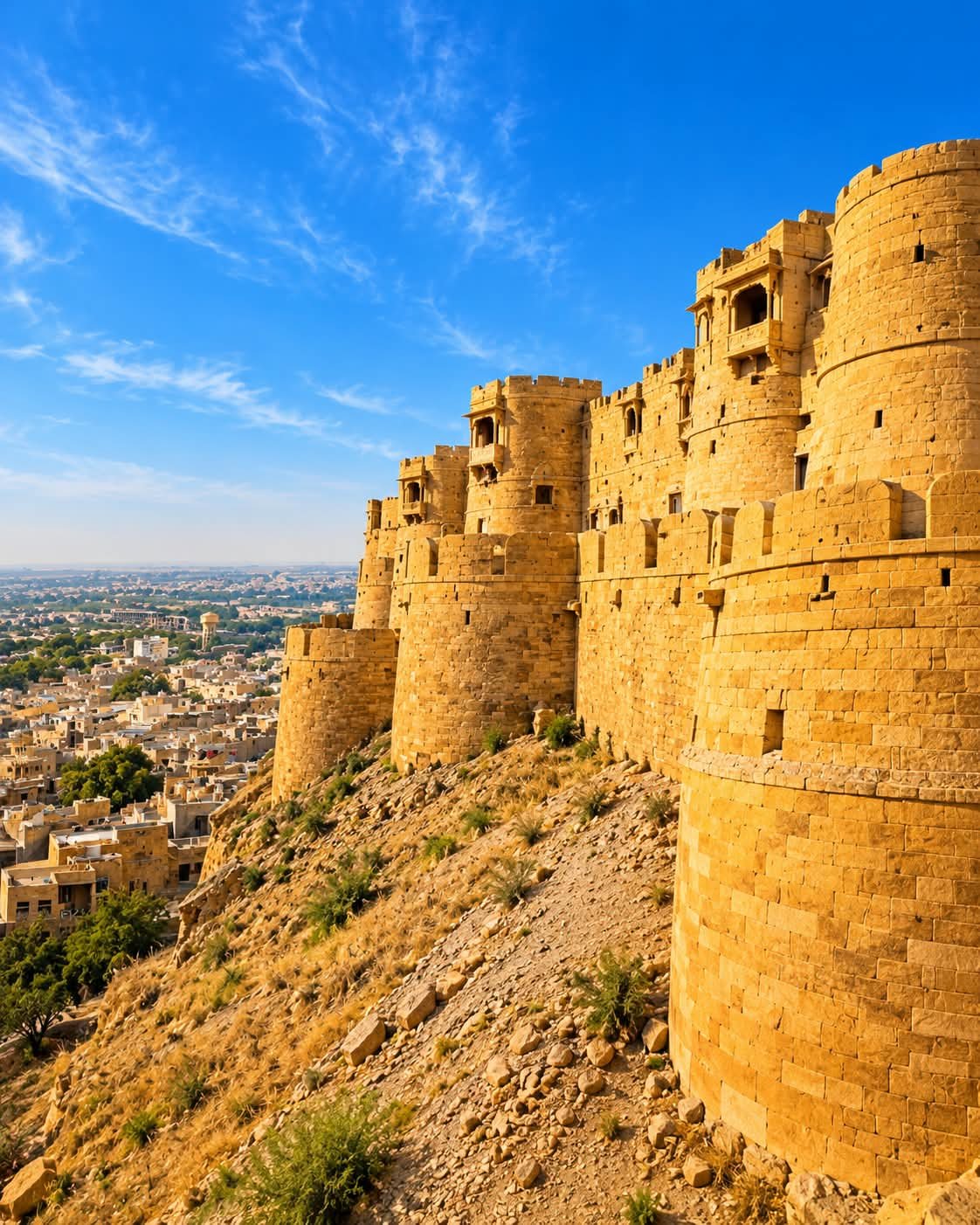
Builders used locally quarried yellow sandstone, which holds up well in the desert climate. People often note that it hardens rather than erodes with age. The outer walls, reported to be around 4.6 metres tall at the base, form the outermost layer of a triple-layered defence. 99 bastions ring the perimeter.
Four Gates
Visitors pass through four main gates: Akhai Pol, Ganesh Pol, Suraj Pol, and Hawa Pol. Each leads deeper into the fort. This layered system was a defensive measure. It forced attackers to fight through several checkpoints before they reached the heart of the fort.
Havelis, Jharokhas and Lanes
Inside the walls, Rajput design blends with later Mughal influences. You can see this in the carved jharokhas (projecting balcony windows), the ornate archways, and the detailed stonework on havelis, temples, and the royal palace. Many havelis date to the 19th century. Merchant families who prospered from Jaisalmer’s trade built them. Narrow, winding lanes connect these buildings. The layout shows how the fort grew organically as a working city rather than a single planned complex.
Inside Jaisalmer Fort: What Can You See?
Inside, you will find a compact, self-contained town. It has homes, guesthouses, shops selling textiles and handicrafts, small restaurants, temples, and the royal palace complex. Narrow stone lanes connect everything, and most vehicles cannot fit through them.
The Raj Mahal, or Royal Palace, is the fort’s most prominent structure. Jaisalmer’s rulers once lived in this multi-storeyed building. Today it partly operates as a museum, with royal artefacts, historical photographs, and the palace’s original chambers and balconies.
Beyond the palace, the Jain temple complex is a major attraction. Several viewpoints along the bastions offer views over the town and the surrounding desert. Walking the lanes is one of the best experiences, because everyday life inside the walls makes the fort distinctive.
Jain Temples Inside the Fort
The fort houses a cluster of interconnected Jain temples. Sources generally cite seven temples built between the 12th and 15th centuries. That makes them roughly contemporary with the fort, or slightly later. They honour various Jain Tirthankaras. Visitors admire their detailed sandstone carving, intricate pillar work, and the passageways that link several shrines into one complex.
The temples remain active places of worship. In keeping with Jain customs, visitors should remove footwear and leather items, such as belts and wallets, before entering. Please respect any prayer or ritual in progress, and do not treat the temples as just another sightseeing stop.

Jaisalmer Fort Timings
People live and work inside the fort, so it has no fixed opening or closing hours. You can generally enter at any time. The Fort Palace Museum keeps its own schedule, commonly reported as 9:00 am to 6:00 pm daily. Museum timings, temple hours, and seasonal changes can shift. Confirm current hours locally or through official sources before you plan around a specific time.
Jaisalmer Fort Ticket Price
The fort itself generally charges no entry fee, since it is an inhabited part of the city. Specific attractions, such as the Fort Palace Museum, charge their own fees. Reported figures are roughly Rs. 50 for Indian nationals and Rs. 250 for foreign visitors, plus an extra charge for cameras. Some recent listings cite a higher foreigner price, closer to Rs. 600, so fees may have changed. Heritage sites in India update ticket prices from time to time. Confirm the current Fort Palace fee, and any Jain temple charges, through official or local sources.
Best Time to Visit Jaisalmer Fort
October to March is generally the most comfortable period. Daytime temperatures in the Thar Desert are much cooler than in summer. Between April and June, temperatures can climb into the mid-40s Celsius. That makes it hard to explore the fort’s exposed lanes and bastions at midday. Even in the cooler months, early morning and late afternoon are more pleasant. They also give better light for photographing the sandstone.
Sunrise, Sunset and Night Views
The sandstone walls change colour through the day. They look a deeper gold at sunrise and sunset, when low sunlight hits the stone. Many visitors head to the western bastions or nearby rooftop viewpoints in the late afternoon to watch this effect over the town and desert.
After dark, lights often illuminate the fort, creating a striking view from around the city. Several rooftop restaurants near and inside the fort suit evening visits. The fort is residential at night, so keep noise down and respect privacy in the quieter lanes.
How to Reach the Fort
The fort sits at the centre of Jaisalmer city, so it is easy to reach from most areas. Jaisalmer’s railway station connects well to Delhi, Jaipur, and Jodhpur. It lies a short distance from the fort by local transport. The nearest major airport is in Jodhpur, roughly 285 kilometres away. Most travellers continue from there by road. Highway buses and taxis also link Jaisalmer with neighbouring cities. Within the city, you can walk to the fort from most central hotels and markets, or take an auto-rickshaw or taxi from further out.
Parking Near the Fort
The interior lanes are narrow and unsuitable for vehicles. Most visitors park outside and walk in from the main entrance. Parking is generally available near the main gate. Space can run short during peak tourist season. If you arrive by taxi or private vehicle, expect to walk the final stretch.
Restaurants and Food Near the Fort
Restaurants and cafes operate both inside the walls and in the surrounding markets. They range from simple local eateries to rooftop restaurants with elevated views, especially popular at sunset. Operators change often, so this guide does not recommend specific places. Check current listings and reviews closer to your visit.
Photography Tips
The sandstone architecture is one of the fort’s most photographed features. Plan around the light. Early morning and late afternoon bring the richest golden tones. Midday sun looks flatter and harsher. Exterior bastions and gateways make strong wide shots. The narrow lanes, carved havelis, and temple details suit closer shots.
Photography may be restricted in parts of the Jain temple complex, so check the rules on-site. Residents live here, so be considerate. Ask permission before you photograph people or their homes.
Tips for Visiting Jaisalmer Fort
- Wear comfortable, sturdy footwear. The lanes have uneven stone surfaces and some inclines.
- Carry water, especially outside the cooler winter months.
- Dress modestly, and remove footwear and leather items before entering the Jain temples.
- Visit in the early morning or late afternoon for cooler temperatures and better photography light.
- Remember that people live here. Keep noise down in quiet lanes and respect residents when taking photos.
- Expect narrow lanes and some crowding in peak season, particularly around the palace and temples.
- Hire a licensed guide at the entrance for historical context, because signage inside is minimal.
Nearby Places to Visit
Several of the city’s other major heritage sites lie close by. Patwon Ki Haveli is the largest haveli complex in Jaisalmer. Nathmal Ki Haveli and Salim Singh Ki Haveli are two other well-known mansions. All three stand in the old city, so you can usually combine them with a fort visit in one day of walking. Gadisar Lake is a historic water tank on the edge of the old city. It offers a calmer experience and is popular around sunset. Together, these sites form the core of most Jaisalmer itineraries, with the fort as the central anchor.
For more on the region, read about the fort’s background on Wikipedia.
Frequently Asked Questions About Jaisalmer Fort
History and Heritage
It is famous as one of the world’s few “living forts”, where thousands of residents still live. It is also known for its golden sandstone architecture, its Jain temple complex, and its history as a Silk Road trading centre.
Sonar Quila means Golden Fort. The name comes from the yellow sandstone, which glows golden in sunlight, particularly at sunrise and sunset.
Rawal Jaisal, a ruler of the Bhati Rajput clan, built it in 1156 CE as the new capital of his kingdom.
Sources date the fort to 1156 CE, which makes it roughly 870 years old.
Yes. The fort houses a complex of interconnected Jain temples, generally cited as seven temples built between the 12th and 15th centuries.
Planning Your Jaisalmer Fort Visit
The fort has no fixed hours, and you can generally enter at any time. The Fort Palace Museum keeps its own schedule, commonly reported as 9:00 am to 6:00 pm. Confirm current hours locally.
Entry to the fort is generally free. The Fort Palace Museum charges a separate fee, commonly reported as Rs. 50 for Indians and Rs. 250 or more for foreign visitors. Confirm current pricing before you go.
Yes, you can access the fort at night because people live there, and lights often illuminate it after dark. The palace museum and temples keep daytime hours.
October to March offers the most comfortable temperatures. Summer brings extreme desert heat.
Getting There and Staying
Yes. Several heritage hotels and guesthouses operate within the walls, so you can stay inside the living fort.
The station is a short distance from the fort within the city. An auto-rickshaw or taxi gets you there easily.
Parking is generally available near the main entrance. Vehicles cannot enter the narrow interior lanes, and space can run short in peak season.