
Vyas Chhatri Jaisalmer: History, Timings, Entry Fee & Travel Guide
Vyas Chhatri Jaisalmer: golden sandstone cenotaphs honouring Sage Vyas, with one of the city’s best sunset views
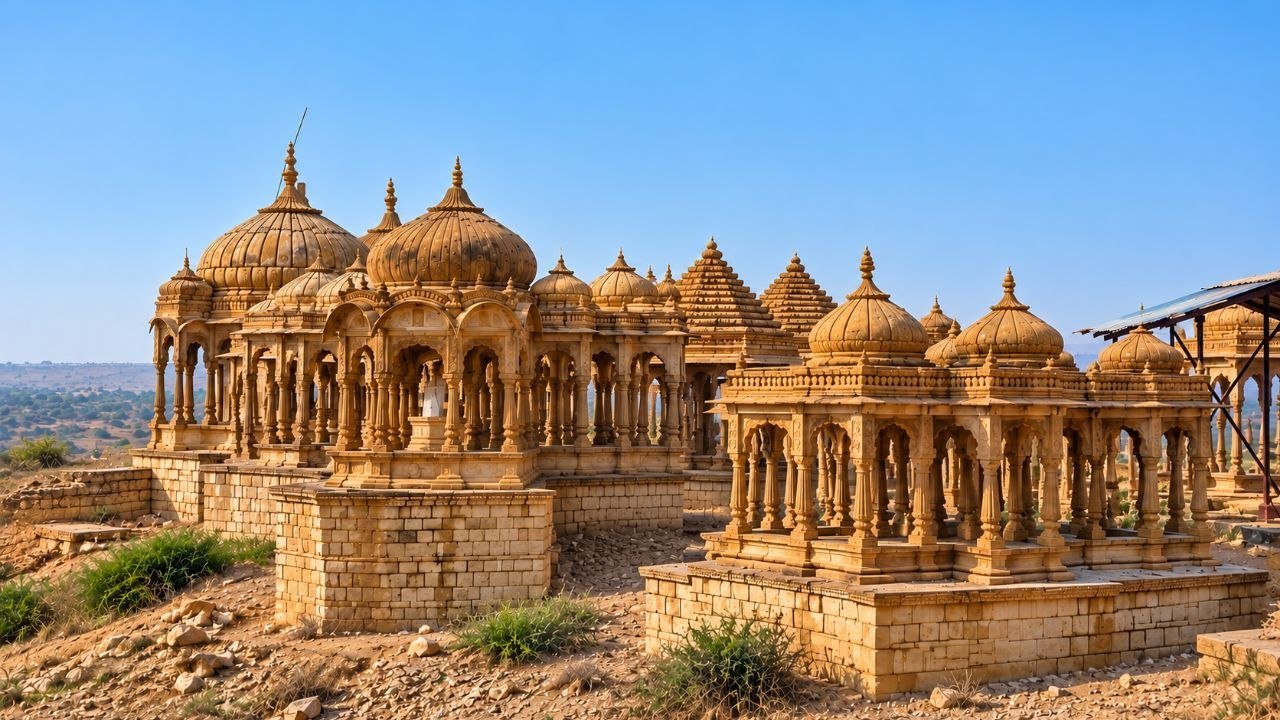
Vyas Chhatri Jaisalmer is a cluster of golden sandstone cenotaphs on the northwestern edge of the city. It offers one of the most popular sunset views in the Golden City.
The site honours the sage Ved Vyas, author of the Mahabharata. It is also one of Jaisalmer’s most photographed heritage spots.
Despite its popularity, many travellers confuse Vyas Chhatri with the better-known Bada Bagh nearby. In addition, different sources describe the link between the two sites differently. This guide explains what Vyas Chhatri actually is. It also covers the history, practical visiting details and how the site relates to Bada Bagh, so you can plan with accurate expectations.
What Is Vyas Chhatri Jaisalmer?
Vyas Chhatri is a cluster of memorial cenotaphs, known locally as chhatris. Builders used Jaisalmer’s characteristic yellow sandstone. The site works as a Brahmin cemetery, linked to the Pushkarna Brahmin community. It includes a cenotaph for Sage Vyas, set toward the north of the structure. This cenotaph honours the sage whom tradition credits with compiling the Mahabharata.
Bada Bagh, in contrast, commemorates Jaisalmer’s royal family. Vyas Chhatri is mainly a memorial and cremation ground for Brahmins. As a result, it has a different character and cultural meaning, even though the two sites share a similar architectural style.
History and Significance of the Cenotaphs
Local Brahmin families built these cenotaphs over time as memorials to individuals. This follows the wider Rajasthani tradition of raising chhatris to honour the dead. The most prominent structure, and the site’s namesake, is the cenotaph dedicated to Sage Vyas. It reflects the reverence that Hindu tradition holds for him as the author of the Mahabharata.
However, this is not a purely historical monument. The site still serves as an active memorial and cremation ground for the Pushkarna Brahmin community. Therefore, visitors should show the same respect they would at any burial or memorial ground. The site still holds real cultural and religious meaning for local families.
Architecture and Design of the Cenotaphs
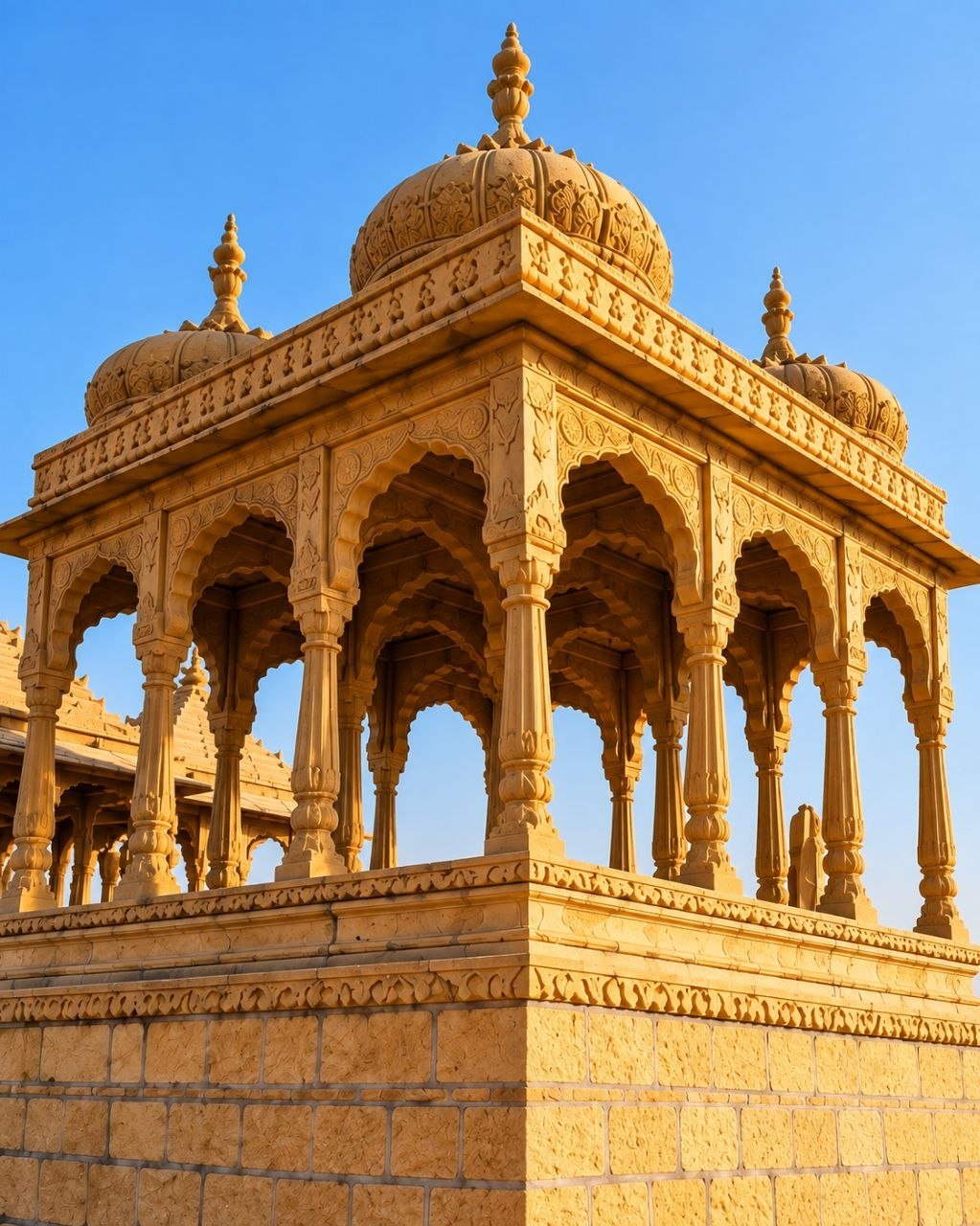
Golden-hued sandstone forms the cenotaphs. Each stands on a raised platform and carries a domed pavilion on finely carved pillars. This design broadly matches the chhatri architecture found across Rajasthan.
The carvings on the pillars and platforms reflect the same sandstone tradition seen in Jaisalmer’s havelis and monuments. Visitors often compare the overall effect to Bada Bagh’s cenotaph complex, because the style and material are so similar.
Some visitors say Vyas Chhatri has more individual cenotaphs than Bada Bagh. However, this comes from visitor observation, not from an official count. Treat it as a general impression, not a verified fact.
Why the Site Is Famous
Two things make the site famous today. First, its architectural beauty as a cluster of golden sandstone cenotaphs. Second, its reputation as one of the best sunset viewpoints in Jaisalmer. The elevated position on the edge of the city gives a wide view over Jaisalmer. As the evening light changes, you can often see the silhouette of Jaisalmer Fort in the distance.
Vyas Chhatri Jaisalmer as a Sunset Point
Visitors and local guides widely rate it as one of Jaisalmer’s best sunset spots. They often mention it alongside Bada Bagh, and some even prefer it for evening views. The site sits high on the northwestern edge of town. As a result, it offers an open, largely unobstructed view of the sky and the surrounding desert. In some directions, you can also see distant windmills. Casual visitors and photographers both enjoy it.
Most travellers arrive in the late afternoon, well before sunset. This gives them time to find a good vantage point and watch the evening light change on the cenotaphs.
The exact sunset time shifts through the year, so this guide does not state a fixed hour. Instead, check the local sunset time for your travel dates and arrive with enough margin.

Vyas Chhatri Jaisalmer Timings
Visitors and local sources generally describe the site as open from morning until sunset. However, this guide cannot confirm official, currently verified opening and closing hours.
Timings at heritage and memorial sites can change. Therefore, confirm current visiting hours locally before you plan your trip. This matters most if you want to time your visit around sunset.
Vyas Chhatri Jaisalmer Entry Fee
Some visitor accounts mention a modest entry fee. Past visitors cite figures of roughly Rs. 30. However, this guide cannot confirm a current, official ticket price.
Authorities revise fees at Indian heritage sites from time to time, so they may differ from older visitor reports. Check the current entry fee locally or through an official source before you visit.
How to Reach the Site
Vyas Chhatri sits on the northwestern edge of Jaisalmer city. Most visitors reach it by local taxi, auto-rickshaw or hired vehicle from the main part of town. It lies at the edge of the urban area, not within easy walking distance of the fort or the central market. Many visitors combine the trip with other nearby attractions, since distances on this side of the city are fairly short.
Location and Directions
The site sits along Dedansar Road on the northwestern side of Jaisalmer, in the general direction of Bada Bagh. Outer roads in Jaisalmer can be easy to misjudge without local knowledge. Road conditions and route options can also vary. Therefore, confirm directions through a local map service or a driver. Do not assume a fixed route.
Are Vyas Chhatri Jaisalmer and Bada Bagh the Same?
Sources genuinely disagree here — this guide won’t force a clean answer it can’t back up.
Some tourism sources place Vyas Chhatri within the Bada Bagh complex itself. They treat it as part of the same site. Other sources, including visitor reviews, describe it as a separate, nearby location with its own road. They also note that visitors sometimes confuse the two because the chhatri architecture looks so similar.
We can say with more confidence that the two sites serve different purposes. Bada Bagh’s cenotaphs commemorate Jaisalmer’s royal family. They grew over several centuries, starting broadly in the 16th century. In contrast, Vyas Chhatri’s cenotaphs link to the Pushkarna Brahmin community and centre on the memorial to Sage Vyas.
Because of this ambiguity, treat the two as separate stops on your itinerary. Do not assume one combined visit covers both. Also confirm the current layout and access with a local guide or driver. For the same reason, this guide gives no distance figure between the two sites.
Best Time to Visit
Like most of Jaisalmer, the site is most comfortable in the cooler months, broadly October through March. Daytime and evening temperatures are then far milder than in the peak summer heat.
Within a single day, the late afternoon and early evening work best. Timing your visit to catch the sunset gives you both comfort and the site’s signature views.
What to See and Do
- View the cluster of yellow sandstone cenotaphs, including the memorial dedicated to Sage Vyas.
- Examine the carved pillars and domed pavilions typical of Rajasthani chhatri architecture.
- Watch the sunset from the elevated vantage point, with Jaisalmer Fort often visible in the distance.
- Photograph the cenotaphs as they take on a warmer golden tone in the evening light.
- Take in the wider desert landscape and, depending on the direction, distant windmills.
Tips for Visiting
- First, arrive well before sunset to find a good vantage point and see the site in changing light.
- Wear comfortable footwear suited to sandy, uneven terrain.
- Confirm current timings and entry fees locally before your visit.
- Remember that this remains an active memorial and cremation ground for the local Brahmin community, and behave respectfully.
- Carry water, especially if you visit outside the cooler winter months.
- If you combine the trip with Bada Bagh, confirm current directions and travel time locally. Do not assume the two sites sit side by side.
Places to Visit Near Vyas Chhatri Jaisalmer
Bada Bagh, with its own complex of royal cenotaphs, is the most common pairing. The architecture is similar, and it shares the reputation as a sunset viewpoint. However, as noted above, confirm the current route between the two. Do not assume a short walk connects them.
Within the wider city, some travellers also combine Vyas Chhatri with a day of sightseeing. That day can include Patwon Ki Haveli, Salim Singh Ki Haveli and Nathmal Ki Haveli. You can add Gadisar Lake and Jaisalmer Fort itself. If you have time, the Sam Sand Dunes are another popular stop.
Still, Vyas Chhatri lies on the edge of town. As a result, most visitors treat it as a separate stop timed around sunset. They rarely fold it into the walking route through the city’s central heritage sites.
Is It Worth Visiting?
The site suits travellers interested in Rajasthani cenotaph architecture or sunset photography. It also suits anyone who wants a quieter alternative to more crowded viewpoints in Jaisalmer. Past visitors consistently cite it as one of the city’s best places to watch the sunset, so most people consider it a worthwhile stop.
However, it needs a short trip out to the edge of town. It is not a casual add-on to a central-city walking route. Therefore, plan it as a deliberate stop timed around the evening light, not as an afterthought.
Frequently Asked Questions
About the Site
It is known for its cluster of golden sandstone cenotaphs, including a memorial to Sage Vyas. It is also one of Jaisalmer’s most popular sunset viewpoints.
It sits on the northwestern edge of Jaisalmer city, along Dedansar Road, in the general direction of Bada Bagh.
Yes, if you enjoy sunset views and Rajasthani cenotaph architecture. Most people consider it a worthwhile and relatively quick stop on a Jaisalmer itinerary.
Vyas Chhatri and Bada Bagh
Sources differ on this. Some place Vyas Chhatri within the Bada Bagh complex, while others call it a separate, nearby site. However, the two commemorate different things. Bada Bagh honours Jaisalmer’s royal family, and Vyas Chhatri links to the local Brahmin community.
No reliably confirmed distance exists, because sources describe the two sites differently. Therefore, confirm the current route locally.
Planning Your Visit
People generally describe the site as open from morning until sunset. However, confirm current official hours locally before you visit.
Some visitor reports mention a modest fee. This guide cannot confirm a current official price, so check locally before your visit.
Yes. People widely rate it as one of the best sunset spots in Jaisalmer, thanks to its elevated position and open views over the city and the surrounding desert.