
Longewala War Memorial: History, Battle of Longewala & Visitor Guide
Longewala War Memorial marks the site of the 1971 Battle of Longewala, deep in the Thar Desert near the India-Pakistan border. It honours the soldiers who held the post.
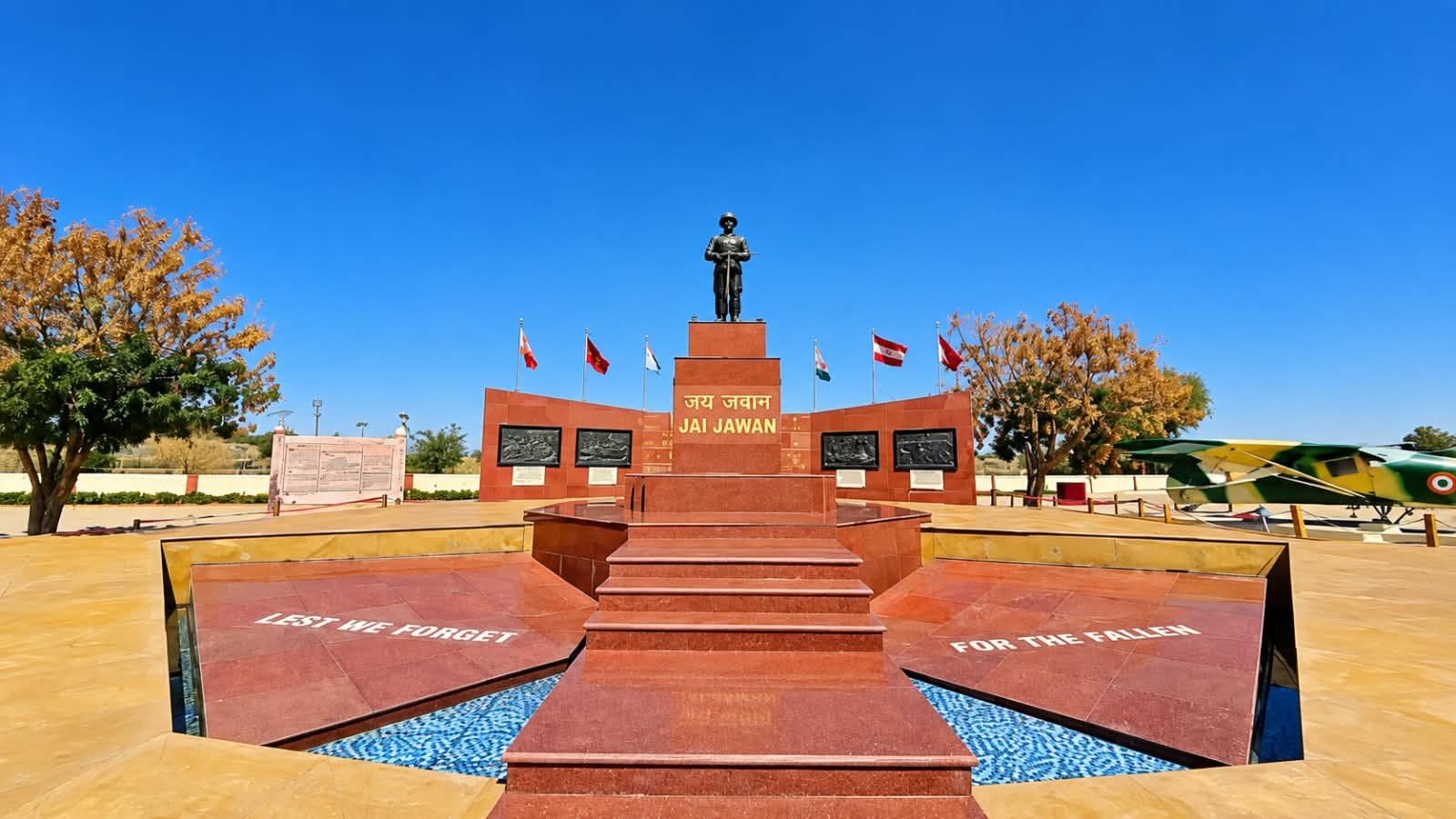
Longewala War Memorial marks the site of the 1971 Battle of Longewala, deep in the Thar Desert near the India-Pakistan border. It honours the soldiers who held the post.
The memorial commemorates the Indian Army’s defence of a small border post against a much larger attacking force on the night of 4–5 December 1971.
In addition, the memorial offers something different from the forts and havelis of Jaisalmer. It is a site of recent military history, set in the open desert that shaped the battle itself. As a result, it draws visitors interested in India’s military past and in the 1971 war. Many others also know the battle from its dramatisation in popular culture.
History of Longewala War Memorial
The memorial honours the soldiers of the Indian Army’s 23rd Battalion, Punjab Regiment, who defended the Longewala post in 1971. It also honours the Border Security Force personnel attached to them and the Indian Air Force pilots who gave air support.
The memorial stands on or near the actual battlefield. Moreover, the Indian Army maintains it as a tribute to the defenders and keeps the memory of the battle alive for later generations.
However, we cannot reliably confirm an exact construction date from available sources, so this guide does not state one. Its purpose, though, is clear. It honours the soldiers who held the post. In addition, it gives visitors a tangible link to the battle. Official military history and Hindi cinema have both kept that story in public memory.
The Battle of Longewala in 1971
The Battle of Longewala began on the night of 4–5 December 1971, in the early days of the Indo-Pakistani War. Fighting at the post lasted through that night and into the next morning. Afterwards, Indian forces spent a few more days consolidating their position. A company of the 23rd Battalion, Punjab Regiment, held the Longewala border post in the Thar Desert.
Why Longewala Mattered
Longewala sat close to the international border. As a result, Pakistani forces tried to use this stretch of desert as a route toward Jaisalmer, as part of their wider offensive in the western sector. The Indian post was lightly defended. However, its position gave it real strategic value. That is why the Pakistani attack focused there.
The Defenders and the Attackers
According to Indian military accounts, the defending company numbered around 120 soldiers. A small group of Border Security Force personnel also supported them. The same accounts describe a Pakistani force of roughly 2,000 to 3,000 troops, backed by several dozen tanks. However, sources differ on the exact numbers. Therefore, treat these figures as commonly cited approximations from Indian military accounts, not as a tally confirmed by all sides.
The Night of 4–5 December
The Indian defenders chose to hold their position instead of withdrawing. They used the terrain, the mines around the post and their defensive preparations to slow the Pakistani armour. Meanwhile, battalion headquarters told them that reinforcements would need several hours to arrive. As a result, the company held on through the night largely alone.
Air Support at Dawn
At dawn, Indian Air Force Hunter aircraft arrived and struck the Pakistani armoured column. Most accounts credit this intervention with halting the advance. In addition, the strikes inflicted heavy losses on the attacking tanks and vehicles.
Major Kuldip Singh Chandpuri and the Defence of Longewala
Major Kuldip Singh Chandpuri of the 23rd Battalion, Punjab Regiment, commanded the post at Longewala. According to accounts of the battle, he moved between positions through the night to coordinate his men. They also say he decided to hold the post instead of attempting a withdrawal under fire.
For his leadership in the engagement, the government awarded Chandpuri the Maha Vir Chakra, one of India’s highest gallantry awards. Afterwards, he continued his military career and retired from the Indian Army as a Brigadier. He passed away in 2018.
Even today, his role at Longewala remains the part of his career most closely tied to his name. It is also the part of the battle that the Indian public knows best through film.
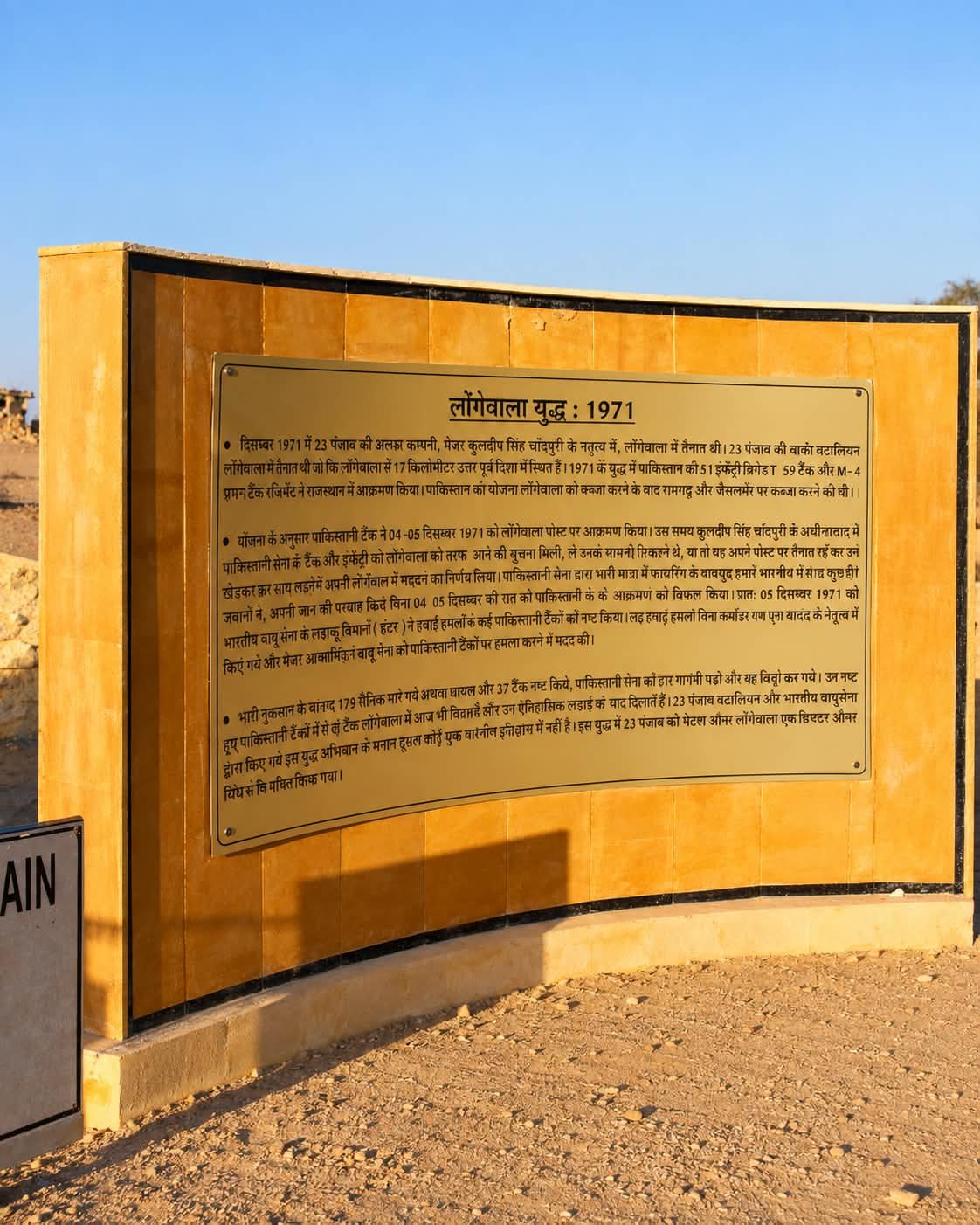
Why the Battle of Longewala Was Significant
Many people regard the Battle of Longewala as a notable engagement of the 1971 war. The reason is the gap between the two forces. A small, well-positioned defending force faced a much larger mechanised attack. Therefore, Indian military history often cites it as an example of a small force holding ground until air support could arrive.
However, we should be precise about its place in the war. Longewala was one engagement in a much larger conflict fought across multiple fronts in December 1971. Therefore, it did not decide the outcome of the war by itself.
Its significance lies elsewhere. First, it showed how ground defence and air support can work together at a critical moment in the western sector. Second, it has become a well-remembered chapter of the war, in military circles and in wider popular memory.
What Can You See at Longewala War Memorial?
Visitors can generally expect a memorial complex with displays about the battle. It also includes military equipment linked to the engagement, such as vehicles connected with the Pakistani armoured column that was halted there. Moreover, information boards and plaques outline the events of the battle night and give context for what you see.
However, facilities at military-maintained sites can change over time. Besides, Longewala remains part of an active military area. Therefore, this guide lists only what people consistently describe as part of the complex.
For this reason, treat any specific facility, such as an indoor museum section, as subject to confirmation on the day. Access and offerings can change for operational or security reasons.

Where Is Longewala War Memorial Located?
Longewala War Memorial is in Jaisalmer district, Rajasthan. It lies in the Thar Desert near the settlement of Longewala, close to the India-Pakistan international border in the western sector. The area also includes the nearby post of Sadewala, linked to the battalion’s wider defensive positions in 1971.
This is a border-adjacent military area, not a conventional tourist site inside Jaisalmer city. Therefore, confirm exact access points and any restricted zones through official channels. Do not assume them from general descriptions.
Jaisalmer to Longewala War Memorial: Distance and Travel
Longewala lies a long way from Jaisalmer city, out toward the international border. Travellers commonly describe the road journey as roughly two hours or more. However, the exact time depends on your route and starting point in Jaisalmer.
Treat this as a general guide, not a fixed number. Road conditions and travel arrangements can change. Therefore, confirm current conditions and travel time before you set out. In addition, parts of the route cross sparsely populated desert and border-adjacent land.
Longewala War Memorial Timings and Visitor Access
Confirm before you go — this is a military-administered site, and access details are not fixed.
Opening hours and visitor access may change, because this is a military-related site in a border area. Therefore, confirm the latest access information before you plan your visit. Do not rely on a fixed schedule.
Also check whether you need permits, identification or advance notice. Military authorities can change these requirements as circumstances demand.
Longewala War Memorial and the International Border
Longewala sits close to the India-Pakistan international border. That proximity gave the area strategic weight in 1971. Today, it remains a sensitive border zone. However, this guide gives no distance figures to the border. It also gives no detail on patrol routes, security arrangements or restricted zones. A general travel guide should not include such information. Moreover, it can change for security reasons.
Military and security regulations govern access near the border. These rules differ from those at typical heritage or tourist sites. Therefore, follow all instructions from military or security personnel while you are in the area.
Best Time to Visit Longewala
The Thar Desert gets extreme summer heat. From roughly April to June, daytime temperatures in the Jaisalmer region often make outdoor sightseeing difficult.
In contrast, the winter months, broadly October through February, are far more comfortable. Cooler daytime temperatures make the journey to Longewala easier. As with most desert travel, an early morning start beats travelling in the afternoon sun, especially given the distance from Jaisalmer.
Things to Know Before Visiting
- First, carry valid identification, since this is a military-associated site where staff may ask for ID.
- Photography restrictions may apply in parts of the site or surrounding area. Follow posted signs and instructions from personnel on the ground.
- Security reasons may restrict access to certain areas, and these restrictions can change without much notice.
- Always follow the instructions of military or security personnel at the site.
- Also confirm current visiting hours, access requirements and permit needs before you travel, given the distance and the border-area location.
- Finally, plan a full day trip from Jaisalmer, and carry enough water and supplies for desert travel.
Places to Visit Near Longewala and Jaisalmer
Longewala sits well outside Jaisalmer city. However, many travellers pair the trip with the city’s core heritage sites. These include Jaisalmer Fort, Patwon Ki Haveli, Salim Singh Ki Haveli and Nathmal Ki Haveli. You can also visit the Sam Sand Dunes and Gadisar Lake.
Because of the distance, most visitors treat Longewala as a separate, dedicated excursion. As a result, it rarely fits into the same day as city sightseeing.
In Jaisalmer city and along suitable travel routes, you can find Rajasthani cuisine. Travellers often try regional dishes such as dal baati churma, bajra roti and ker sangri. However, do not expect food options at the memorial itself.
Frequently Asked Questions
About the Memorial
It commemorates the Battle of Longewala, fought on the night of 4–5 December 1971. In that battle, a small Indian Army company defended a border post against a much larger Pakistani attacking force during the Indo-Pakistani War.
It is in Jaisalmer district, Rajasthan, in the Thar Desert near the settlement of Longewala, close to the India-Pakistan international border.
For travellers interested in India’s military history and the 1971 war, the memorial is a meaningful and historically significant stop. However, it needs a dedicated excursion from Jaisalmer because of the travel distance.
The Battle and Major Chandpuri
On the night of 4–5 December 1971, around 120 Indian Army soldiers, supported by Border Security Force personnel, held the Longewala post against a much larger Pakistani armoured force. Then, at dawn, Indian Air Force Hunter aircraft arrived and struck the advancing column.
He was the Indian Army officer who commanded the defending company at Longewala. He earned the Maha Vir Chakra for his leadership in the battle. Later, he retired from the army as a Brigadier, and he passed away in 2018.
Planning Your Visit
The road journey generally takes upward of two hours from Jaisalmer city. However, the exact distance and time vary with your route and starting point, so confirm current travel details before you set out.
This guide cannot reliably confirm current opening hours, since access at this military-related site can change. Therefore, verify the latest timings before you plan a visit.
Yes, tourists do visit the memorial. However, it sits in a border-area military zone, so expect access rules, identification requirements and possible restrictions that differ from typical tourist sites.
Longewala lies relatively close to the India-Pakistan international border, which shaped its strategic importance in 1971. However, this guide gives no specific distance figures because border-area information is sensitive.
Carry valid identification, plus enough water and supplies for desert travel. The site is remote, and it lies far from Jaisalmer city.